Sunday Snapshot – April week 2

Four book covers

I’ve read so many books this week I needed two photographs to fit them in, but that’s what happens when you include picture books and early readers in your TBR heap.

I absolutely loved Please Mr Panda by Steve Antony.  A gently funny book that reminds children to use their manners and say ‘please’ if they want to get the goodies.

The Dot by Peter H Reynolds is a charming story about doing your best, believing in yourself and not giving up, but it also encourages the reader to pass on the support they have received to other people who are struggling – great advice, no matter what age you might be.

The Memory Tree by Britta Teckentrup and Fox by Margaret Wild are both ‘issue’ books about Foxes.  In The Memory Tree, Fox dies after a long life and his forest friends gather to remember their happy times together.  Margaret Wild’s fox is a trickster who tries to break up a mutually rewarding friendship between a blind dog and a wing-damaged bird.  Both books have been very well received but, unfortunately, neither of them resonated with me.

Five book coversOne of the story books I read this week didn’t have many more words than the picture books.  Under a Silver Moon by Anne Fine is full of good messages about friendship, exercise and healthy eating but, first and foremost, it is a lovely story with glorious line drawings. Funnily enough, that same description would apply to Clean Break by Jacqueline Wilson, but with the addition of family break-ups.

The rest of my books this week were all YA / adult.  Maybe I’d been reading too much Early Years stuff, but none of them were nearly as satisfying or comfortable as the books for young children – but then again, they weren’t meant to be!

It seemed appropriate to read The Daylight Gate by Jeanette Winterson over the Easter weekend, as that was where the book started.  A mix of social history, witches and magic it was a well crafted novel, but the story was very bleak and some of the descriptions were gruesome.  Only Ever Yours by Louise O’Neill is a dystopian novel that made me snarl with feminist indignation.  Set in a world where a chosen few women give birth to only male children and females are designed and made to order I also questioned the science, minimal though it was.  Not a book to read if you are looking for a happy (or even a hopeful) ending.  I really don’t know what to say about the final book in this week’s selection.  A Confederate General from Big Sur by Richard Brautigan defies any sort of neat categorization.  It is funny, trippy, decidedly off-beat and not particularly politically correct and I absolutely loved bits of it.

What will next week’s book bundle bring?  You’ll have to come back in seven days time to find out.  What have you been reading?  Would you recommend it?

Easter Sunday Snapshot

Six book coversThere is plenty of variety in this snapshot of my reading over the past seven days.  I mentioned Minnow on the Say in an earlier blog.  It is a gentle mystery adventure story written in the 1950s, when it was not uncommon for children to be off exploring the countryside on their own at eleven years of age.  Although many of the problems of the modern era were featured (dementia, death, poverty, greed) I felt very comfortable when reading about them.  I can’t decide if this is because I was reading as a grown-up, because of the way it is written or if it’s something to do with the setting.  As someone who grew up with Enid Blyton, Arthur Ransome, Monica Edwards, Noel Streatfield and the Pullein-Thompson sisters, it felt like coming home to read this story.

The Fastest Boy in the World, The Butterfly Club, and Flora & Ulysses all had something in common – they were illustrated to varying degrees.  Flora & Ulysses was subtitled ‘The Illuminated Adventures’ and had as many pictures as it did words.  I do love to see pictures in children’s story books, even if they are just occasional pen sketches.  My childhood memories include many books where there were a large number of pen and ink drawings, especially at the beginning of a chapter, with half a dozen coloured plates inserted at strategic points.  The coloured pages were on a different sort of paper to the rest of the book so they were easy to find.  I would often flick through to those glowing illustrations before I started to read the story and try to work out what might be going to happen.

The illustrations for Revolver were all in my head, but no less vivid.  I listened to the story on spoken word CD and as the voice told the story my mind drew scenes in monochrome.  They were pencil sketches and watercolour washes, overlaid with occasional shocking flashes of colour.  At times it reminded me of the black and white westerns I watched with my family on Sunday afternoon television when I was young.

For Animal Farm, the illustrations came on two different channels.  Last Saturday I went to the Progress Theatre in Reading and saw the story performed by some very enthusiastic young people.  Their use of Lego in the production design was innovative.  The moving parts of the set, including the windmill, were all Lego and the human characters wore yellow Lego masks, complete with the stud on the top of their heads.  The animals were in rustic settings and wore masks that showed much more of their own features than the human masks.  I’d decided not to re-read the book until after I saw the performance so you might expect that the images in my head as I read were reflections of the stage performance.  Instead, I saw black sketches on cream paper, much like those in the stories of my youth.

Why EVERYONE should have a pair of welly boots.

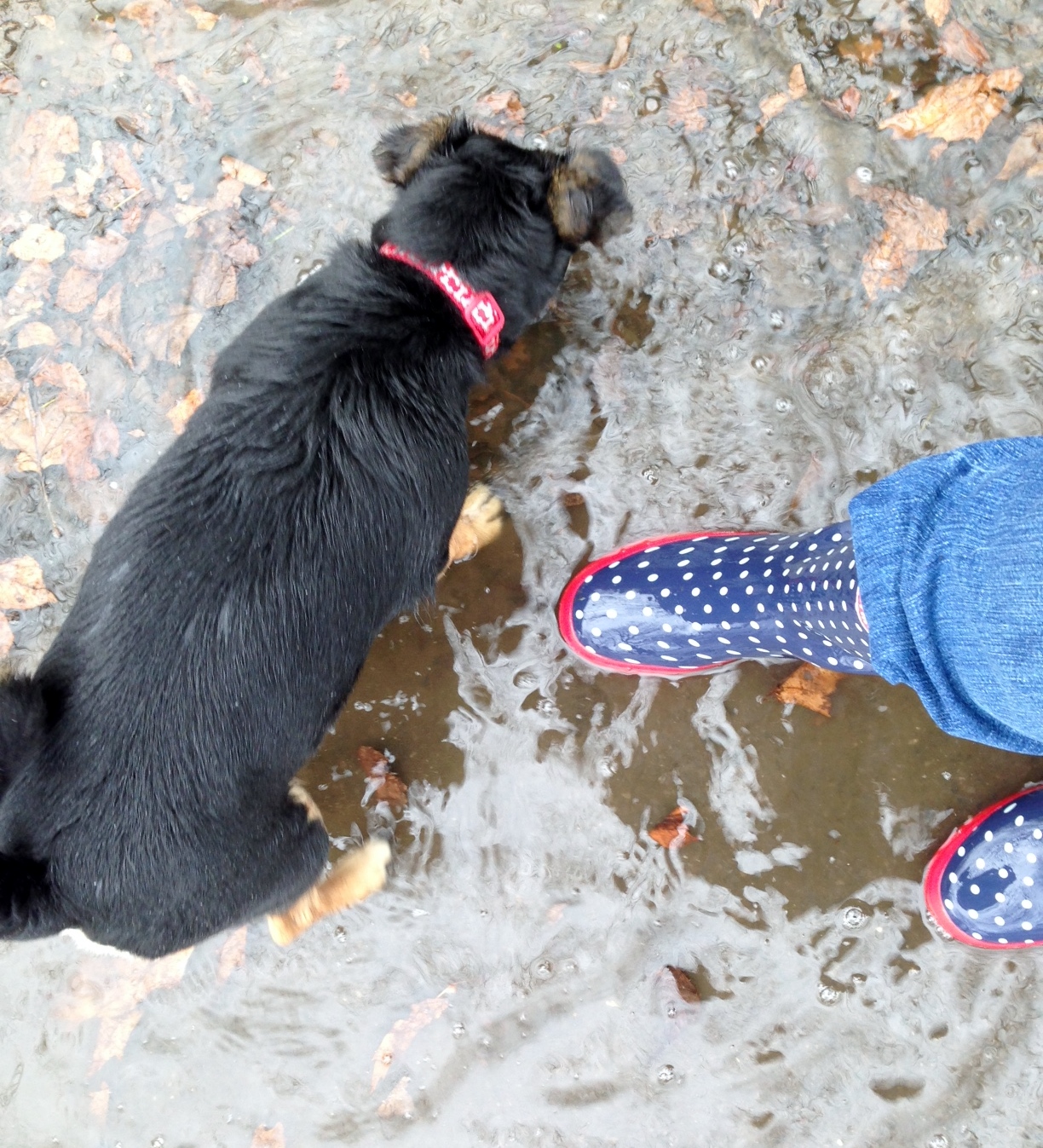
Dog and wellie boot in puddle It’s definitely been wellie boot weather just recently. There’s something very satisfying about splashing through puddles, feet safely encased in their rubber shields.

Scout loves puddles, too. She sticks her snout into them, up to the eyebrows for preference, and roots out interesting things from the bottom. They get unceremoniously dragged to the surface and killed, terrier style, by a jolly good shaking.  If I kick at something floating on the surface or flick water at her she pounces and bounces, yipping and growling with happy excitement.  I feel sorry for the children being walked through the park by adults who carefully steer them around the puddles.  What fun they are missing!

Book coverI’ve been thinking about the story I’m going to write for my dissertation and reading other people’s stories on similar themes. As part of my story takes place on a river, I read Minnow on the Say by Philippa Pearce.  It was written in 1955 – 4 years before I was born – and feels like a different world.  Eleven year old children earning money from a paper round; travelling the countryside by bicycle and canoe without adult supervision, but not until after they’ve finished their household chores.  Taking packed lunches wrapped in sheets of paper and bringing home treasures in their handkerchiefs.

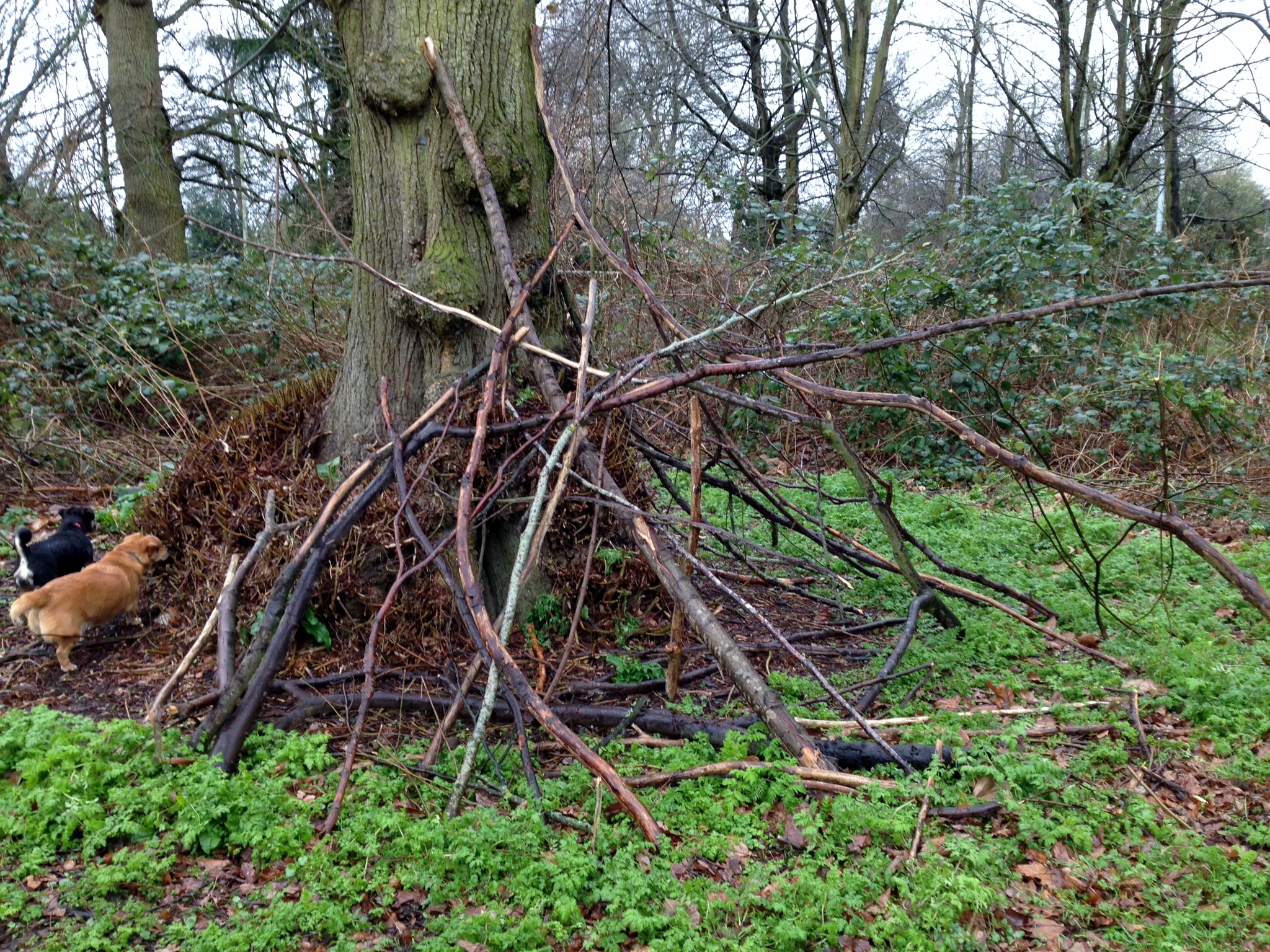
I’m not saying that was necessarily a better way of life, but sometimes I feel like modern children are missing something special.  I understand that parents feel protective, but are the pictures on television as thrilling as those we see for ourselves?  Can finding out about flora and fauna on the internet ever compare to finding a bird’s nest or watching a newt slip into a pond at first hand?  What about climbing trees, padding in streams, building dens. They miss so much … and then I saw this.

Temporary shelter made from roughly assembled sticksAfter the dogs had finished investigating the den, we left the park and headed home.  I had a huge grin on my face.  For all those parents steering their offspring around the ‘dangerous, dirty’ puddles, there are still children who are out exploring and creating their own adventures.  Am I foolish to find hope in this this small thing?

For ‘Thursday’, please read ‘Monday’

Two wheelie bins in the morning sunlightI’m not a huge fan of poetry – please don’t beat me!  In my youth I did a lot of teenage angst poetry writing, but I was never a great fan of reading poetry.  There are, however, a few poems that have stuck in my head over the years.

This morning, whilst walking the dogs, we intercepted the bin men on their rounds.  Something about the sounds of the wheelie bins being emptied and the rhythm of our footsteps opened a door in my memory and I found myself repeating part of a poem I learned at school.  I couldn’t remember all the words so, when I came home, I went searching for it.

In my head I’d been saying ‘Every Monday morning, before you’re quite awake’.  As the poem is about a Thursday morning, it made it harder to track down.  I’m pleased to say I found it, so I thought I would share it with you.

The Dustman

By Clive Sansom

Every Thursday morning
Before we’re quite awake,
Without the slightest warning
The house begins to shake
With a Biff!  Bang!
Biff!  Bang!  Biff! It’s the dustman who begins
Bang!  Crash!
To empty all the bins
Of their rubbish and their ash
With a Biff!  Bang!
Biff!  Bang!  Crash!

A Sunday Story Snapshot

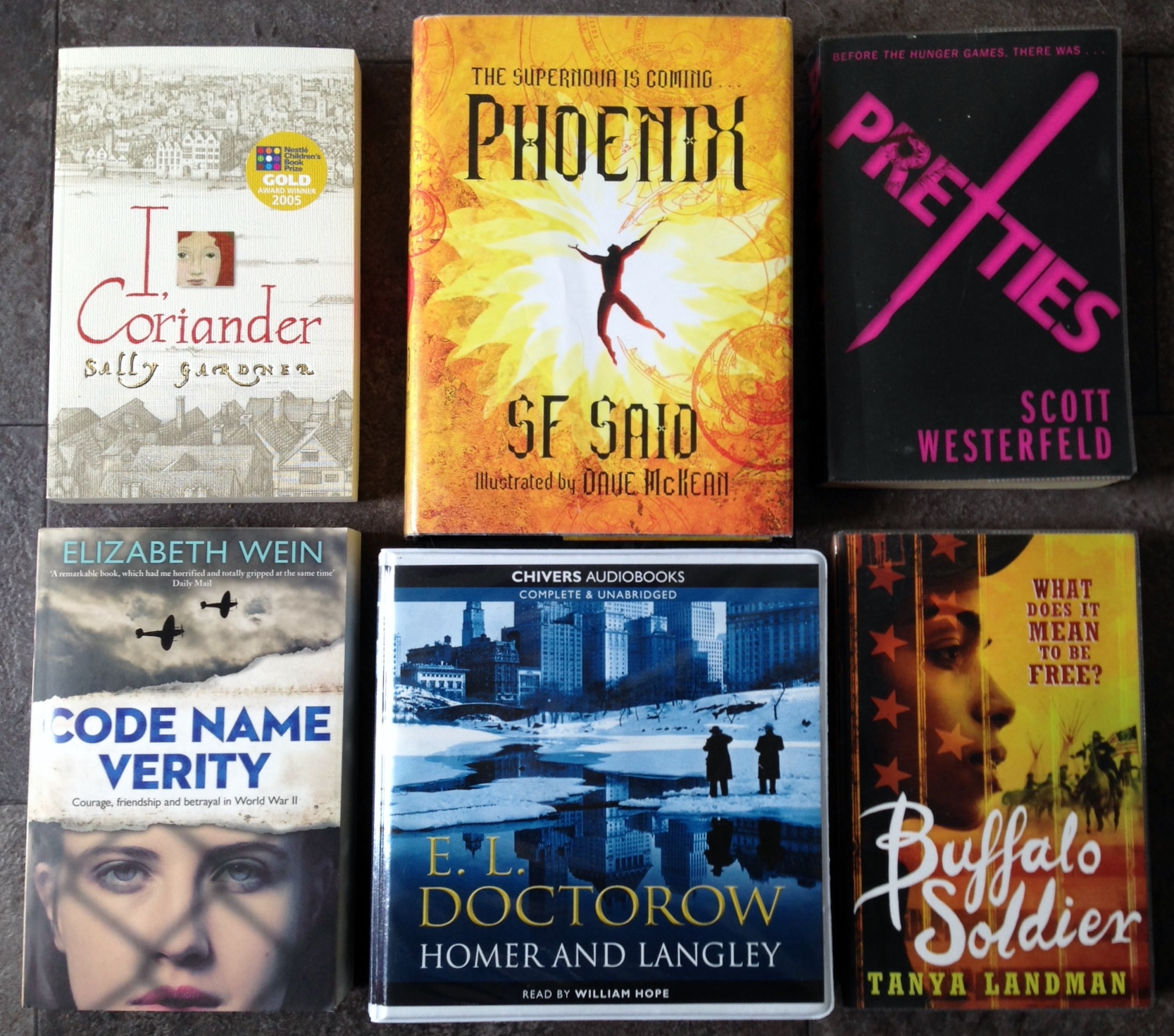
Six book coversIf you were to ask me if I enjoy reading Historical Fiction, I would probably say ‘No!’.  I suppose it makes me think of history classes at school, bodice ripping, the politics of marriage and dry lists of Kings and Queens.  Now look at the six books in this picture – all of which I have read (or re-read) in the past week.  Four of them could easily fall under the Historical Fiction banner, albeit 20th century, and I thoroughly enjoyed every one.

I think they made such a strong impression on me because they are all jolly good stories with strong characters and well crafted narratives.  No preaching or thrusting handfuls of things I ‘ought’ to know in my face, even though they are full of fascinating and sometimes horrific detail.  In retrospect it is obvious that the authors have put a great deal of effort in researching the historical settings but they never let their research get in the way of telling the story.  If you haven’t read Code Name Verity, Buffalo Soldier, Homer and Langley or I, Corriander because you are wary of historical fiction, please give them a try.  They are all well worth requesting from the library.

So, four historical novels and three fantasies – yes, I know that adds up to seven, but I Corriander has a very pretty foot in both camps.  Now I’ve finished Pretties I’ve requested the third book in Scott Westerfeld’s series, so I won’t say anything more about that for now in case you’ve only read the first book.  That just leaves Phoenix.  Wow!  A breathtaking combination of illustration and text that I absolutely adored.  I read it in less than a day and am thinking about reading it again before it goes back to the library.  I may have to add it to my wish list in the hope that the birthday bunny will bring me my own copy.


If you go down to the library today…

When I’m not studying at / for college, walking the dogs, reading, carrying out domestic duties or checking out my social media sites in front of the TV, I have a job.  Well, Kim A Howard cuddling the big blue Bookstart bearactually I have two – I am the Bookstart Co-ordinator for Hampshire and also a casual library assistant at some of the libraries in the north of the county. From time to time I write articles for work – this is my latest guest blog.  It was for the Professional Association for Childcare and Early Years – known as PACEY – and is about the activities child minders, carers and parents might find in their local library.

Click on the PACEY logo to follow the link – I hope you enjoy the post.  If you have a young child and don’t take them to the library, I hope this might inspire you to do so.

PACEY Logo


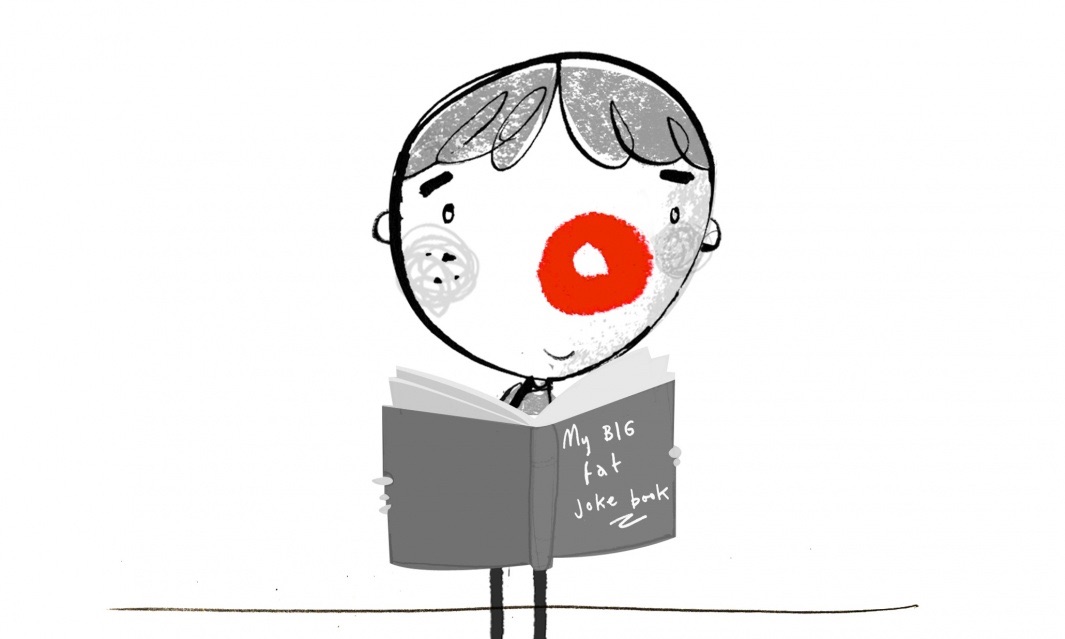
Giggling Is Good

I love a good giggle, a silly snigger or a stomach aching storm of laughter.  It makes me feel good.  It makes me happy.  Most of the time hearing other people chuckle makes me want to join in.  OK, I admit it – sometimes if I am in full grouch mode, the sounds of merriment make me seethe with resentment. Thankfully, that is an exception to the rule.

Illustration: Tom McLaughlin

Illustration: Tom McLaughlin

This article by Tom McLaughlin for The Guardian appeared in my Twitter feed this morning. Should I tell the world that I was reading Twitter on the phone during a pee-break at work? Probably not! Anyway, I was feeling tired and a bit gritty and grotty and reading Tom’s words made me snort, loudly, several times, in the privacy of my little cubicle.  I apologise to the other ladies using the facilities for any discombobulation this may have caused.  I hope you enjoy reading it as much as I did.

Why Yes, I Should Write About Politics

John Scalzi, talking sense in 2008. Still applies now. I would add, however, that the opinions of a character are not, necessarily, the opinions of the author. It’s called FICTION for a reason!

Automattic Special Projects's avatarWhatever

Over on his site, Paolo Bacigalupi asks the question “Should Fiction Writers Write About Politics?” in the wake a of reader comment after Paolo did, indeed, write about politics. While Paolo answers the question to his own satisfaction (I encourage you to read it), let me state my own, probably unsurprising, opinion here:

Why yes, fiction writers should write about politics, if they choose to. And so should doctors and plumbers and garbage collectors and lawyers and teachers and chefs and scientists and truck drivers and stay-at-home parents and the unemployed. In fact, every single adult who has reason enough to sit down and express an opinion through words should feel free to do just that. Having a citizenry that is engaged in the actual working of democracy matters to the democracy, and writing about politics is a fine way to provide evidence that one is actually thinking about these…

View original post 942 more words

I don’t like to complain, but …

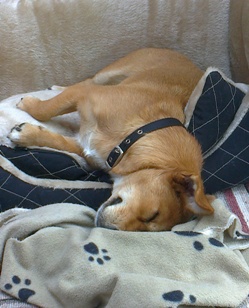
Sleeping dog hanging out of basketI like a quiet life.  There – I’ve confessed.  I’m not much of an adventurer or a party animal.  I enjoy the occasional concert, movie or trip to the theatre.  I like going for walks, curling up with a book, eating nice food, listening to music, snuggling and cuddling.  I DO NOT LIKE FIREWORKS … OR BALLOONS … OR ANYTHING THAT GOES BANG.

My plan this evening was to sit at the dining room table with my laptop and catch up with some outstanding assignments on the Blogging 101 course I’m doing.  Instead I’m sat on the floor, tapping one-handed on the keyboard, trying to calm to dogs who are shaking and drooling with fear because some (insert your expletive of choice here) is setting off fireworks at 6:30 on a Saturday night.

My dogs are usually pretty chilled (check the picture of Tucker) but fireworks send them to pieces.  On the evenings when you usually expect fireworks (Bonfire Night, New Year) we make sure all the blinds and curtains are drawn, have the TV on extra loud and even give them some medication to try to help them relax.  I’ve not found anything that works totally, but it does take the edge off things for them.  Events like tonight when the bangs and flashes are unexpected and unannounced give me, other pet owners, parents of nervous children and anxious people who are spooked by loud noises no chance to prepare or protect ourselves or our loved ones.

Our Blogging 101 assignment was to include a ‘new to you’ element and to address it to your ideal audience.  In the ordinary scheme of things, my ideal audience would have been agents, editors and publishers of books for children but, today, my ideal audience is anyone who sends up fireworks and my ‘new’ thing is a plea to you to think twice before sending up a rocket or lighting a Catherine Wheel.  They look pretty, but to lots of people and creatures they can be terrifying.

Rant over.